
Precision Terminal Riveting in Automotive Relays: Minimizing Mechanical Stress and Contact Deformation
Pneumatic impact riveting introduces peak transient stress that causes silver contact tilting and terminal springback. Closed-loop servo riveting captures real-time force-displacement envelope, limiting riveting depth tolerance to ±0.003mm and maintaining contact resistance <0.3mΩ after forming. This process satisfies IATF 16949 traceability requirements for safety-critical automotive relay assemblies.
Mechanics of Contact Deformation under Pneumatic Shocks
Pneumatic riveting delivers impulse force in 10~20ms. Uneven stress distribution creates plastic deformation at the silver-copper bonding interface. Contact tilt >0.02mm increases contact resistance and accelerates fretting corrosion under vehicle vibration.

| Riveting Type | Repeatability | Max Riveting Force | Stroke Velocity | Maintenance Interval | Relative Capex |
|---|---|---|---|---|---|
| Pneumatic Impact Riveting | ±0.02 mm | 8000 N | 120 mm/s | 1200k cycles | Low |
| Closed-loop Servo Riveting | ±0.003 mm | 7500 N | 10~80 mm/s adjustable | 2000k cycles | Medium |
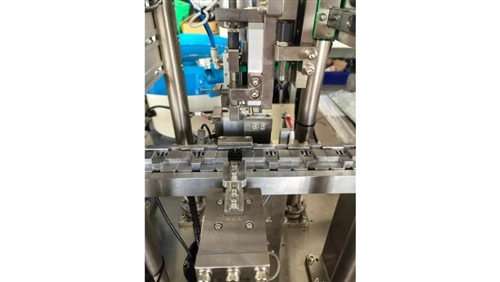
Relay Terminal Riveting Machine
Tool Steel (Powder Metallurgy) Life Cycles
Powder metallurgy HSS punch resists micro chipping under repeated cold forming. Surface coating TiCN increases tool life to 2,800,000 cycles. Tool wear threshold is set at 0.002mm dimensional shift for automatic tool change reminder.

Case Study: Cutting Scrap Rate to 0.05%
An automotive relay Tier1 replaced pneumatic riveting stations with closed-loop servo riveting. First pass yield rose from 98.2% to 99.95%. Contact resistance drift failure dropped from 1.1% to 0.05% under 1000h vibration aging test.