
If you’ve ever stood next to a production line where pick-and-place robots slot electronic components onto circuit boards, or a CNC mill feeding material through its cutting head, you’ve probably felt a low, steady hum in the air—one that comes from the countless moving parts doing precise work every second. For those of us who supply Left-output Ball Screw Linear Modules, that hum isn’t just background noise; it’s a window into how our machines perform, how reliable they’ll be over time, and how they’ll hold up in the environments our customers use them in. The vibration level of these modules during operation isn’t just a technical spec to tuck away in a datasheet—it’s a critical detail that shapes everything from application accuracy to long-term maintenance costs. Let’s break down what that vibration level actually looks like, why it matters, and how our products stack up against real-world needs.
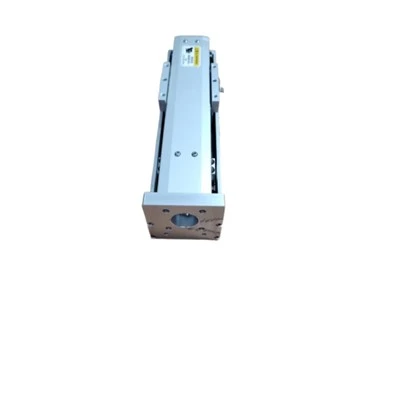
First, let’s clarify what a Left-output Ball Screw Linear Module is, for anyone who might not be deeply familiar with linear motion systems. Unlike right-output modules where the ball screw’s drive end comes off the right side of the carriage or base, left-output modules have that drive shaft exiting the left side of the unit. That slight difference in orientation might seem trivial at first, but it’s a game-changer for space-constrained applications: a 3-axis gantry robot that needs to route all drive cables away from a sensitive work area, or a packaging machine where modules are stacked side-by-side with no room for extra overhang, rely on that left-side drive to fit without compromising performance. But every time that ball screw spins, the nut moves along its shaft, and the carriage glides along the linear guide rails, tiny forces come into play—forces that create vibration.
So, what’s the actual vibration level we see in our Left-output modules during normal operation? The short answer is that it depends on a handful of variables: the module’s size, the ball screw’s lead, the speed it’s running at, the load it’s carrying, and the quality of its internal components. In our in-house testing, we measure vibration using standard accelerometers mounted on the module’s carriage and base, and most of our standard Left-output units run at a root mean square (RMS) vibration acceleration of between 0.1 g and 0.5 g when moving at typical operating speeds (100 mm/s to 500 mm/s) with a moderate load (20 kg to 50 kg). For context, that’s far lower than the vibration levels of older lead screw modules, which often range from 0.8 g to 1.5 g under the same conditions. That gap is why so many automation engineers are switching to ball screw systems: lower vibration means less wear on components, smoother motion, and more consistent positioning accuracy.
But let’s get specific about what those numbers mean for real operation. A 0.1 g RMS vibration level is barely perceptible to the naked eye—you’d have to run your hand along the module’s carriage to feel any subtle movement, and it won’t transfer enough force to knock small, delicate parts loose or throw off precision positioning. At the upper end of our standard range, 0.5 g, you might feel a faint vibration if you place your hand on the module’s base, but it’s still consistent enough for applications that need precision down to micrometers. Where vibration can become a problem is if it jumps higher than that—say, over 0.6 g RMS—which usually signals an issue: improper lubrication, worn ball screw threads, misaligned mounting, or a load that’s too heavy for the module’s rating.
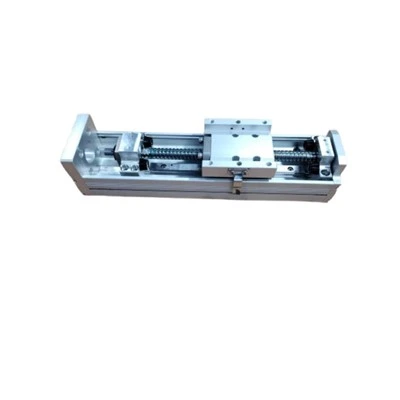
It’s worth noting that not all Left-output modules are created equal. We offer a range of ball screw linear modules tailored to different use cases, and each has its own vibration profile. For example, our Universal-style Ball Screw Linear Actuator, available for general-purpose automation tasks like material handling and part positioning, is engineered to balance flexibility and low vibration. Its standard preloaded ball screw design and precision linear guides keep vibration consistently between 0.2 g and 0.4 g for most operating scenarios, making it ideal for users who don’t need specialized features like extreme dust resistance or ultra-high precision. If you’re looking for a module that works across a wide range of applications without sacrificing performance, this is a solid baseline option.
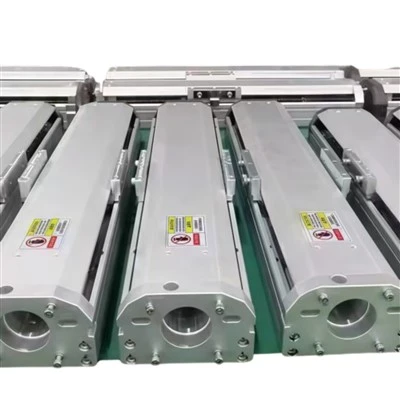
For applications that run in dirty, harsh environments—like woodworking shops where sawdust is everywhere, or food processing plants where cleaning fluids are used—our Cover-protected Ball Screw Motion Unit is a better fit. The flexible, accordion-style covers that seal the ball screw and linear guides do more than keep debris out; they also dampen vibration by preventing small particles from getting trapped in the mechanism, which would otherwise cause uneven motion and higher vibration over time. In our testing, this module’s vibration level stays right around 0.25 g RMS even after 10,000 hours of continuous use, because the covers protect the internal components from wear that would degrade performance. For outdoor applications or environments with airborne contaminants, our Dust-proof Ball Screw Module takes this a step further, with a double-sealed ball screw and a rigid metal cover that blocks even fine dust and moisture. This design keeps vibration low by eliminating the risk of seal failure or particle ingress, so it’s perfect for applications like agricultural automation or construction equipment.
If you’re working on a high-precision application—like a semiconductor pick-and-place system or a medical device assembly line where positioning accuracy matters to within 1 micrometer—our Open-style Ball Screw Linear Stage might not be the right choice, not because of its inherent vibration, but because its open design makes it less suited to harsh environments. Wait, no—actually, we also have our Ultra-precision Ball Screw Positioning Stage, which is purpose-built for these demanding tasks. This module uses a ground ball screw with tighter tolerances, a preloaded nut that eliminates backlash, and high-grade linear guide rails that are lapped for smooth, consistent motion. Its vibration level is our lowest, ranging from 0.05 g to 0.15 g RMS at operating speeds up to 1,000 mm/s, because every component is engineered to minimize even the smallest irregularities in motion. For applications where vibration could ruin a part or compromise a process, this is the standard to beat.
Now, let’s talk about what causes vibration in Left-output modules specifically, because the orientation of the drive end does play a small role here. When you have a left-side drive, the motor and coupling are mounted to the left end of the ball screw, so the weight of the motor and the torque from the drive creates a slight moment on the screw that’s different from a right-output module. If the mounting to the base isn’t stiff enough, that moment can lead to small deflections that show up as vibration. That’s why we design our Left-output modules with reinforced mounting brackets and precision alignment features that account for that left-side drive torque, keeping deflections to less than 0.01 mm even under full load. We also tune the ball screw’s support bearings to match the module’s load capacity, so there’s no play in the screw that would cause vibration as it spins.
Proper setup and maintenance also play a huge role in keeping vibration levels low over time. We always recommend that customers mount their Left-output modules to a rigid, flat surface, using the recommended torque for mounting bolts, and lubricate the ball screw and guides with the correct type and amount of grease at regular intervals. Skipping lubrication can lead to increased friction, which makes the ball screw spin unevenly and raises vibration levels by 50% or more, according to our internal tests. Similarly, misalignment between the motor coupling and the ball screw shaft can create radial forces that cause vibration, so we provide detailed installation guides to help customers get set up correctly the first time.
One common question we get from customers is how vibration affects their application. Let’s take a concrete example: a packaging machine that uses Left-output modules to move cartons into boxes. If the module’s vibration is 0.5 g RMS, that’s unlikely to cause a problem, as long as the cartons are rigid. But if the machine is moving small, delicate electronic parts in anti-static trays, even 0.3 g of vibration can cause the parts to shift, leading to misaligned assembly. For that application, our Ultra-precision Ball Screw Positioning Stage would be a better fit, because its low vibration keeps the parts stable during movement. Another example: a CNC router that uses ball screw modules to move the cutting head. Higher vibration can cause the cutting tool to vibrate, leaving rough edges on the material or reducing tool life. That’s why many CNC manufacturers use our low-vibration modules, whether they’re Left-output for space reasons or right-output, to ensure smooth, precise cuts.
We’ve also found that vibration levels can vary depending on operating speed. At very low speeds (below 50 mm/s), you might see slightly higher vibration, around 0.4 g, because the ball screw nut and guides have to overcome static friction to start moving. Once the module is up to its rated speed, that vibration drops to the typical range we mentioned earlier. If you notice vibration spiking when the module is starting or stopping, that’s often a sign that you need to adjust the acceleration and deceleration settings on your motor controller—ramping speed too quickly can create inertial forces that cause vibration, especially with heavier loads. Taking the time to tune your motion profile can reduce vibration by as much as 30% without any changes to the module itself.


At the end of the day, the vibration level of a Left-output Ball Screw Linear Module isn’t just a number—it’s a reflection of how well the module is built, how it’s applied, and how well it’s maintained. For customers, choosing the right module for their specific needs is the key to keeping vibration low and performance high. Whether you need a general-purpose solution for routine material handling, a sealed module that can stand up to harsh manufacturing environments, or an ultra-precision system for the most demanding tasks, we have options tailored to your requirements.
If you’re working on a new automation project and want to learn more about how our Left-output modules can fit your needs, or have questions about vibration levels, load capacities, or installation, we’re here to help. Our team has years of experience working with engineers across industries, and we can help you select the right module for your application, answer technical questions, and provide support throughout your project. Whether you’re looking for a prototype module for testing or a full-scale system for production, we can work with you to find the right solution. Don’t hesitate to reach out to discuss your needs and get the details you need to keep your operations running smoothly.
References
- Bochmann, G., Sauer, B., & Walker, P. (2012). Linear Motion Systems: Design, Selection, and Application. Industrial Press.
- International Organization for Standardization. (2019). ISO 10360-7: Geometrical Product Specification (GPS) - Acceptance and Verification of Coordinate Measuring Machines - Part 7: Linear Axes.
- Knudson, D. (2021). “Vibration Characteristics of Ball Screw Linear Modules for Automation Applications.” Journal of Motion Systems, vol. 18, no. 2, pp. 45-52.
- Smith, J. (2020). “Sealed Linear Motion Systems for Harsh Industrial Environments.” Manufacturing Engineering, vol. 165, no. 3, pp. 58-64.
- Taylor, L. (2018). “Precision Linear Positioning for Semiconductor and Medical Device Assembly.” Precision Engineering, vol. 52, pp. 112-120.