
If you’ve ever worked in industries like semiconductor manufacturing, medical device assembly, or precision metrology, you know that even the tiniest error in linear positioning can ruin an entire project. I’ve spent the last decade working with high-precision ball screw linear positioners, and let me tell you—their accuracy, repeatability, and longevity all boil down to the materials we choose. Not just any metals or plastics will cut it here; every component has to perform under tight tolerances, handle consistent loads, and stand up to whatever harsh environment the job throws at it. Let’s break down exactly what goes into these units, and why each material matters.
First, let’s start with the star of the show: the ball screw itself. This isn’t your basic screw from a hardware store. We use two main types of screw materials, depending on the application. For most standard high-precision setups, we go with chrome-plated carbon steel. Wait, why chrome plate? Carbon steel is strong and cost-effective, but it’s prone to rust and wear from repeated ball contact. The chrome plating adds a super hard, smooth surface that reduces friction and prevents corrosion—critical for keeping the ball screw moving smoothly over millions of cycles. For even more demanding jobs, like those in cleanrooms or medical facilities where rust and contamination are non-negotiable, we turn to stainless steel, specifically 440C stainless. It’s corrosion-resistant by nature, and we heat-treat it to get its hardness up to around 58-60 HRC (Rockwell hardness), which is on par with the chrome-plated carbon steel, so it holds up just as well to the rolling balls. The screw’s pitch and diameter are also precision-machined, with tolerances as tight as ±0.001mm per 300mm of travel—something that only works if the base material is consistent in density and doesn’t warp over time.
Next, the ball bearings that ride between the screw and the nut. These tiny balls might seem insignificant, but they’re the reason the ball screw has so much less friction than a standard lead screw. We use ceramic bearings 90% of the time, not steel. Zirconia oxide (ZrO2) is our go-to material here. Why? Ceramic balls are lighter than steel, so they accelerate faster, have less rolling resistance, and wear much more evenly over millions of cycles. They’re also non-conductive, which is a big plus for applications like semiconductor handling where electrical arcing can damage delicate wafers. For super high-load applications, we’ll mix in some steel balls, but even then we use chrome steel (52100 grade) that’s precision-ground to a spherical tolerance of ±0.25μm—so small you can barely see the difference in size. The nut that holds these balls is another key component, usually made of high-tensile aluminum alloy or ductile iron. Aluminum is lightweight, good for high-speed setups, while ductile iron is stronger for heavier loads. We machine the nut’s internal thread grooves to match the screw exactly, then coat it with a solid lubricant like molybdenum disulfide or a PTFE-based coating to keep friction low without needing constant oiling—perfect for sealed units.
Then there’s the linear rail system that guides the positioner along its path. A high-precision positioner isn’t just the screw; it needs a stable, straight path to move along, so it doesn’t drift off-course. We use cold-drawn precision steel rails, heat-treated to the same 58-60 HRC hardness as the screw. The surface is ground flat and straight to within ±0.0005mm per 1000mm of length—insane, right? The rail’s cross-section is usually square or round, depending on the design. For open-frame units, we might use round rails made of carbon steel, which are lighter and easier to assemble, but for enclosed or sealed units like our sealed-protected ball screw motion platform, we go with square rails because they have higher load capacity and better rigidity. The rail’s mating components—linear bearings or guide blocks—are similar to the ball screw’s nut, with ceramic or steel balls and hardened races to reduce friction.
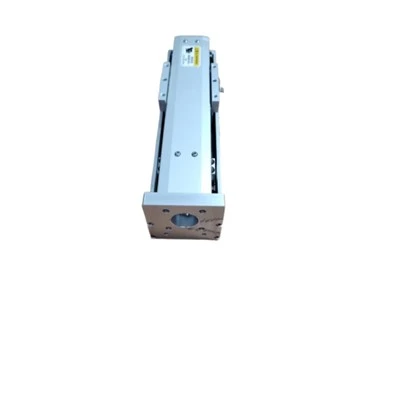
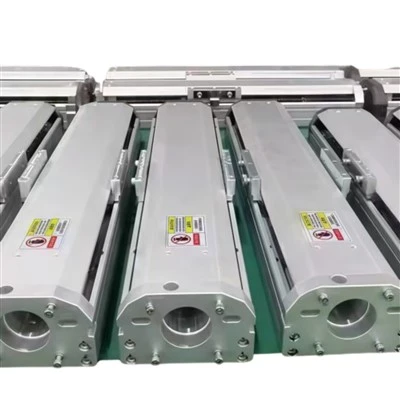
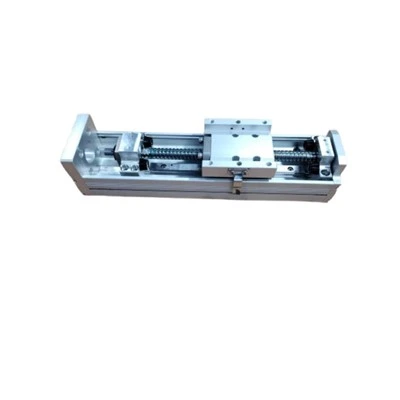
Now, the housing and protection components. This is where a lot of cheaper positioners cut corners, but here’s the thing: even the best ball screw will fail if dust, moisture, or debris gets into it. The housing materials vary by the level of protection needed. For open-frame designs like our open-frame ball screw motion module, we use anodized aluminum alloy. It’s lightweight, corrosion-resistant, and easy to machine into the rigid frames needed to hold the rails and screw in alignment. Anodizing also gives it a hard, scratch-resistant surface that holds up in shop floors or lab environments. For enclosed units, like our dust-sealed ball screw linear carriage, we use a mix of materials: the main housing is cast aluminum or glass-filled nylon for lighter duty, while for heavy loads we use cast iron. The seals are a huge part of this too—we use nitrile rubber (NBR) or polyurethane lip seals, depending on the environment. NBR is good for general use, resistant to oils and mild chemicals, while polyurethane holds up better to abrasion from dust or debris. Some units also have bellows or metal covers to fully enclose the screw and rail. Our cover-protected ball screw motion unit uses a steel or polyurethane bellows that extends and retracts with the carriage, keeping out fine particulates like silicon dust from semiconductor fabs. For the most severe environments, like food and beverage processing with frequent washdowns, we go with stainless steel enclosures, like our enclosed-protected ball screw linear actuator, which is fully resistant to water and corrosive cleaners.
Wait, did I mention lubrication? Even though we use low-friction materials, the right lubricant is non-negotiable, and it’s not just any grease. We use synthetic oils or greases, often PFPE (perfluoropolyether) for high-temperature or vacuum applications, because they don’t break down even at extreme temps or in low-pressure environments. For sealed units, we fill the nut and bearing housing with a precise amount of grease during assembly—too much will cause excess friction, too little will lead to wear. Some units use central lubrication systems, but for most high-precision setups, we use lifetime lubrication, meaning the amount of grease is calculated to last for the entire service life of the unit, so there’s no need for regular maintenance.
Let me give you a real example of why all these materials matter. Last year, a customer in the medical device space came to us with a problem: their old positioner was drifting by 0.02mm after only 10,000 cycles, which was making it impossible to assemble tiny surgical stents. We swapped out their carbon steel screw for a heat-treated stainless steel one, replaced steel balls with zirconia ceramic balls, and upgraded the seals to our dust-sealed design. The result? Their drift dropped to less than 0.002mm after 100,000 cycles, and they haven’t had a single failure in 18 months. That’s the difference between choosing the right materials and cutting corners.
Of course, no two applications are the same. If you’re in a cleanroom making semiconductors, you can’t have any outgassing from materials, so we use materials that meet SEMI standards, like stainless steel and PTFE coatings. If you’re lifting heavy loads for automotive parts handling, we use ductile iron nuts and higher-load steel balls. And if you’re working in a cold storage environment where regular grease would thicken up, we use low-temperature synthetic lubricants that keep the unit moving smoothly at -40°C.
Here’s the thing I want people to take away: high-precision ball screw linear positioners aren’t just assembled parts—they’re engineered systems where every material choice has a purpose. You can’t put a cheap steel screw and plastic nut together and expect the same accuracy, longevity, or resistance to harsh conditions. That’s why we test every component at every step: we check the screw’s straightness with a laser, test the ball bearing friction in a controlled environment, and run the entire unit through a million-cycle durability test before it leaves our shop.
If you’re in the market for a positioner that needs consistent, reliable precision for your application, don’t just go for the cheapest option. Think about what environment you’ll be using it in, what load and travel length you need, and how much accuracy you require. Our range of ball screw linear modules is built with these exact material choices in mind, from open-frame units for general use to fully sealed models for the toughest jobs. If you want to talk through your specific needs or get a quote for a custom unit, reach out to our team to discuss your requirements.


References:
- ISO 3408-1:2019, Ball screws – Part 1: Vocabulary and designation
- SEMI Standard F117-1107, Materials for use in semiconductor manufacturing equipment - Outgassing test method
- ASME B5.48-2015, Linear Motion Ball Screws and Ball Nut Assemblies
- "Ceramic Ball Bearings for Precision Motion Control", Motion Control Engineering Journal, 2022
- "Corrosion Resistance of Stainless Steel for Linear Actuators in Harsh Environments", Journal of Manufacturing Processes, 2021