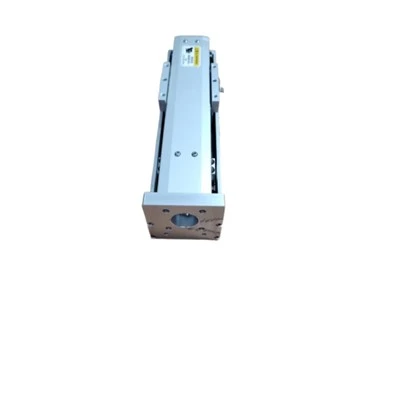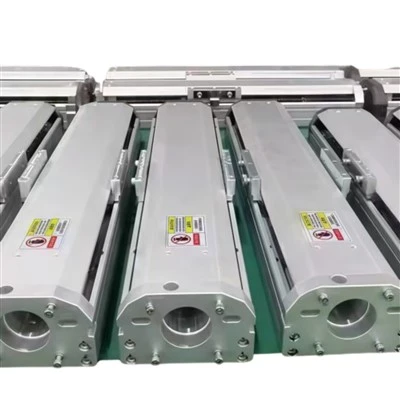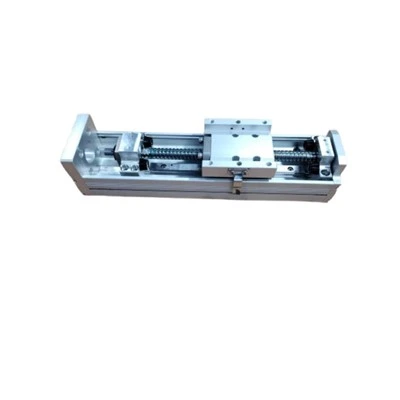

As a trusted supplier of Left-end Motorized Ball Screw Linear Actuator, I am often asked about various technical parameters and characteristics of our products. One particularly crucial question that frequently arises is: What is the maximum deceleration time of a left - end motorized ball screw linear actuator? In this blog post, I will delve into this topic in detail, exploring the factors that influence the maximum deceleration time and providing insights for better understanding and application.


1. Understanding the Left - end Motorized Ball Screw Linear Actuator
Before we discuss the maximum deceleration time, it's essential to have a clear understanding of what a left - end motorized ball screw linear actuator is. This type of actuator consists of a ball screw, which converts rotational motion into linear motion, and a motor attached to the left - end of the assembly. The motor provides the power to drive the ball screw, enabling precise and efficient linear movement.
Our company offers a wide range of left - end motorized ball screw linear actuators, each designed to meet different application requirements. Whether it's for industrial automation, robotics, or other precision motion control systems, our actuators are known for their high performance, reliability, and durability.
2. Factors Affecting the Maximum Deceleration Time
The maximum deceleration time of a left - end motorized ball screw linear actuator is influenced by several factors. Let's take a closer look at each of them:
2.1 Load Mass
The mass of the load that the actuator needs to move plays a significant role in determining the maximum deceleration time. A heavier load requires more force to decelerate, and thus, it will take longer to come to a stop. According to Newton's second law of motion (F = ma), where F is the force, m is the mass, and a is the acceleration. When decelerating, the force required to stop the load is proportional to its mass. For example, if you double the mass of the load, the deceleration force needed to bring it to a halt within the same distance will also double.
2.2 Motor Torque
The torque output of the motor is another crucial factor. A motor with higher torque can generate more force to decelerate the load. This means that with a more powerful motor, the actuator can achieve faster deceleration and shorter deceleration times. However, it's important to note that the motor's torque capacity also needs to be balanced with other factors such as the load inertia and the mechanical efficiency of the ball screw mechanism.
2.3 Ball Screw Lead
The lead of the ball screw refers to the distance the nut travels along the screw axis in one complete revolution of the screw. A larger lead allows for faster linear movement but may require more significant force to decelerate. On the other hand, a smaller lead provides more precision but may result in slower overall movement. When considering the maximum deceleration time, the ball screw lead influences the relationship between the rotational speed of the motor and the linear speed of the actuator.
2.4 Friction and Mechanical Efficiency
Friction within the ball screw assembly and other mechanical components can affect the deceleration process. Higher friction means more energy is dissipated during deceleration, which can increase the deceleration time. Our left - end motorized ball screw linear actuators are designed with high - quality ball screws and bearings to minimize friction and maximize mechanical efficiency, thus reducing the impact of friction on the deceleration performance.
3. Calculating the Maximum Deceleration Time
To calculate the maximum deceleration time, we can use the following basic kinematic equation:
[v = v_0+at]
where (v) is the final velocity (which is 0 when the actuator comes to a stop), (v_0) is the initial velocity, (a) is the deceleration, and (t) is the time. Rearranging the equation to solve for (t), we get:
[t=\frac{v - v_0}{a}]
The deceleration (a) can be determined by considering the forces acting on the load. The net force (F_{net}) acting on the load during deceleration can be calculated using Newton's second law (F_{net}=ma). The net force is the sum of the motor - generated deceleration force and the frictional force.
However, in real - world applications, the calculation can be more complex due to factors such as the non - linearity of the motor torque, the variation of friction with speed, and the dynamic behavior of the load. Therefore, it's often necessary to use simulation software or conduct experimental tests to accurately determine the maximum deceleration time.
4. Importance of the Maximum Deceleration Time
Understanding the maximum deceleration time of a left - end motorized ball screw linear actuator is crucial for several reasons:
4.1 Safety
In applications where precise and controlled movement is essential, such as in automated machinery and robots, knowing the maximum deceleration time helps ensure the safety of the equipment and operators. By setting appropriate deceleration parameters, the actuator can come to a stop smoothly and without causing any damage or accidents.
4.2 Precision
In precision motion control systems, such as those used in semiconductor manufacturing and medical devices, the ability to accurately control the deceleration time is vital for achieving high - precision positioning. A shorter and more predictable deceleration time allows for more precise movement and reduces the risk of overshoot or undershoot.
4.3 Efficiency
Optimizing the deceleration time can also improve the overall efficiency of the system. By reducing the time it takes for the actuator to come to a stop, the cycle time of the process can be shortened, leading to increased productivity.
5. Related Products and Their Advantages
In addition to our left - end motorized ball screw linear actuators, we also offer a variety of related products that may be suitable for different applications:
- Right - angle Coupled Ball Screw Actuator: This actuator is designed with a right - angle coupling, which allows for more flexible installation and space - saving. It is ideal for applications where the motor needs to be mounted in a non - linear configuration.
- Cover - protected Ball Screw Motion Unit: The cover - protected design provides additional protection for the ball screw and other internal components, making it suitable for harsh environments where dust, debris, or moisture may be present.
- Open - frame Ball Screw Motion Module: This module offers easy access to the internal components, making it convenient for maintenance and customization. It is a popular choice for applications that require frequent adjustments or modifications.
- Open - frame Ball Screw Motion Unit: Similar to the open - frame motion module, this unit provides an open - frame design for easy access and customization. It is a versatile option for a wide range of applications.
6. Conclusion and Call to Action
In conclusion, the maximum deceleration time of a left - end motorized ball screw linear actuator is influenced by multiple factors, including load mass, motor torque, ball screw lead, and friction. Understanding and optimizing this parameter is crucial for ensuring the safety, precision, and efficiency of the motion control system.
If you are interested in our left - end motorized ball screw linear actuators or any of our related products, we welcome you to contact us for more information and to discuss your specific application requirements. We have a team of experienced engineers who can provide professional advice and support to help you choose the right product for your project.
References
- Beer, F. P., Johnston, E. R., Mazurek, D. F., & Cornwell, P. J. (2019). Vector Mechanics for Engineers: Statics and Dynamics. McGraw - Hill Education.
- Schmidt, C. (2010). Linear Motion Technology: A Guide for Selection and Application. Schaeffler Technologies AG & Co. KG.