
Bending and Trimming Lead Wires: Managing mechanical stress to avoid component body fractures
Lead forming and trimming operations control residual stress on diode and resistor bodies. Excessive bending moment creates microcracks, causing intermittent open circuits under thermal cycling. Cutting blade clearance is maintained at 0.03 mm; lead length tolerance ±0.05 mm. Refer to High-Frequency Feeding of Micro Components and Key Points for Non-Standard Equipment Selection for more mechanical design guidelines.
High-Speed Robotic Insertion: Mechanical chuck design and optical polarity confirmation
Pneumatic micro chucks pick radial lead components. Telecentric machine vision verifies diode polarity before insertion. Cycle time <0.7 s per part. Poka-Yoke mechanical interlock rejects reversed components before pressing into relay cavities.
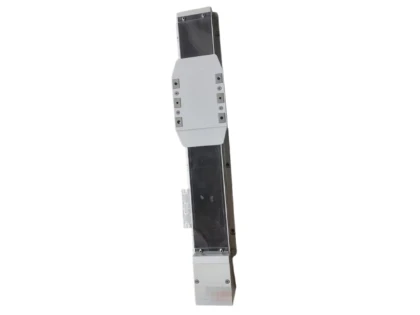
Download Detailed 3D CAD (.STEP) Models for Linear Actuators for insertion mechanism layout validation.
Request your full RFQ selection sheet and FAT acceptance specification from our engineering team via Submit Inquiry.

Equipment Comparison Table
| Evaluation Parameter | Robotic Resistor & Diode Insertion System | Manual Semi-Automatic Assembly Bench |
|---|---|---|
| Placement Repeatability | ±0.01 mm, stable after continuous 24h non-stop operation | ±0.12 mm, deviation drifts with operator fatigue |
| Single-Part Cycle Time | <0.7 seconds per relay component set, continuous feeding | 6 ~ 10 seconds for one component, manual pick & alignment |
| Maximum Insertion Thrust | 180 N servo-controlled press force with real-time force feedback | 80 N fixed spring pressure without force monitoring |
| Scheduled Maintenance Interval | 20,000 operating hours for linear motion and vision modules | 3,000 operating hours for hand fixtures and cutting blades |
| Relative Capital Expenditure | Higher upfront investment, low long-term labor cost | Low initial cost, high recurring labor and rework expense |
| Polarity Verification Method | Telecentric vision inspection + mechanical poka-yoke interlock | Human visual check, prone to human error |
| Inline Quality Functions | Lead trimming, coplanarity check, solderability test, electrical contact resistance test | Separate offline inspection station after assembly finished |
| Line Integration Ability | Compatible with upstream component feeding and downstream relay crimping stations | Standalone unit, cannot connect to automatic production line |
| Rework Rate | ≤0.08% under normal continuous production | 2.5% ~ 4% rework rate caused by misinsertion or reversed polarity |
| Changeover Time Between Relay Part Numbers | 22 minutes full recipe swap with quick-change tooling cassettes | 90 ~ 120 minutes manual adjustment for every new relay model |