Belt-Driven Linear Guides for Long-Stroke Conveyance
-
Steel-cord polyurethane belt driven linear guides deliver high speed for long-stroke gantry conveyance, with repeatability ±0.05 mm at maximum velocity 5 m/s. Permanent belt elongation and structural resonance are the two dominant failure modes for spans exceeding 2 m. This article defines physical calculation methods and hardware selections to suppress stretch and resonance for continuous 24/7 automation conveyance.
-

Steel-cord polyurethane belt elongation physics
-
Polyurethane timing belts with embedded steel cords exhibit 0.02% elastic elongation under rated tension. Permanent elongation accumulates after millions of acceleration cycles, caused by micro-slip between steel cords and PU matrix. Elongation calculation formula:
\(\Delta L=\frac{F\times L_0}{E\times A}\) \(\Delta L\) = belt elongation; F = applied tension; \(L_0\) = free span length; E = tensile modulus of steel cord; A = cross-sectional area of tension cords. For stroke >2000 mm, pre-tension must be set to 30–40% of belt breaking force to reduce incremental stretch. CTA: Download Detailed 3D CAD (.STEP) Models for Linear Actuators via Linear Motion Mechanics
Pulley profiles (AT5, AT10, HTD) backlash review
Belt Driven Linear Module: Long Stroke Linear Guide
Product drawing
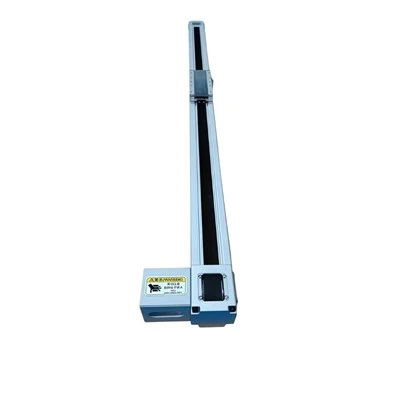


Basic feature
| Parameter | AT5 | AT10 | HTD 5M/8M |
|---|---|---|---|
| Tooth Geometry | Modified trapezoid | Modified trapezoid | Curvilinear round tooth |
| Backlash | Low | Low-Moderate | Low |
| Max Allowable Tangential Force | Medium | Heavy | Heavy |
| Noise Level | Medium | Medium | Low |
| Recommended Stroke | ≤1.5 m | 1.5~3 m | >2 m |
| Relative Capex | Low | Medium | Medium |
AT10 and HTD profiles suit long stroke conveyance. Mismatched belt-pulley tooth profiles generate periodic backlash and resonant vibration. See our industrial belt guide rail drive module for standard belt driven linear assemblies.