Preventative Maintenance Schedule for Automated Relay Riveting and Assembly Machinery
This maintenance regime governs cycle-based wear control for closed-loop servo riveting stations on relay assembly lines. The core objective is to hold positional repeatability within ±0.005 mm, maintain cycle time <0.8 s, and sustain Cpk ≥1.67 over 20 million production cycles. Unplanned downtime mainly originates from punch galling, linear guide lubrication failure, and solenoid sticking caused by condensed moisture in pneumatic circuits.
High-Wear Tooling Lifecycle: Punches, anvils, and feeder track wear thresholds Tooling degradation directly shifts rivet compression force and increases contact resistance >0.5 mΩ on finished relay contacts. Wear judgment strictly follows dimensional loss rather than runtime.

| Component | Inspection Frequency | Allowable Wear Limit | Proactive Replacement Cycle | Failure Consequence |
|---|---|---|---|---|
| Riveting Punch | Every 500,000 cycles | ≤0.01 mm diameter loss | 2,000,000 cycles | Rivet deformation, contact resistance out of tolerance |
| Rivet Anvil | Weekly (visual + micrometer check) | ≤0.008 mm surface indentation | 3,000,000 cycles | Uneven crimping, batch scrap |
| Feeder Track | Bi-weekly | ≤0.02 mm side clearance increase | 12 months | Part jamming, Poka-Yoke interlock trigger |
| Feed Spring | Cycle-count based | 15% drop in spring tension | 500,000 cycles | Feeding misalignment |

- Use a micrometer to measure punch shank diameter before each batch run.
- Record surface roughness Ra; replace when Ra > 0.8 μm.
- Reset servo force-displacement envelope after punch replacement to avoid over-stroke riveting.
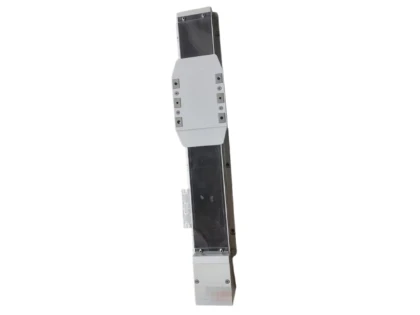
Download Detailed 3D CAD (.STEP) Models for Linear Actuators and riveting tooling. Read more on our automatic production line for magnetic latching relays to match tooling with line speed.